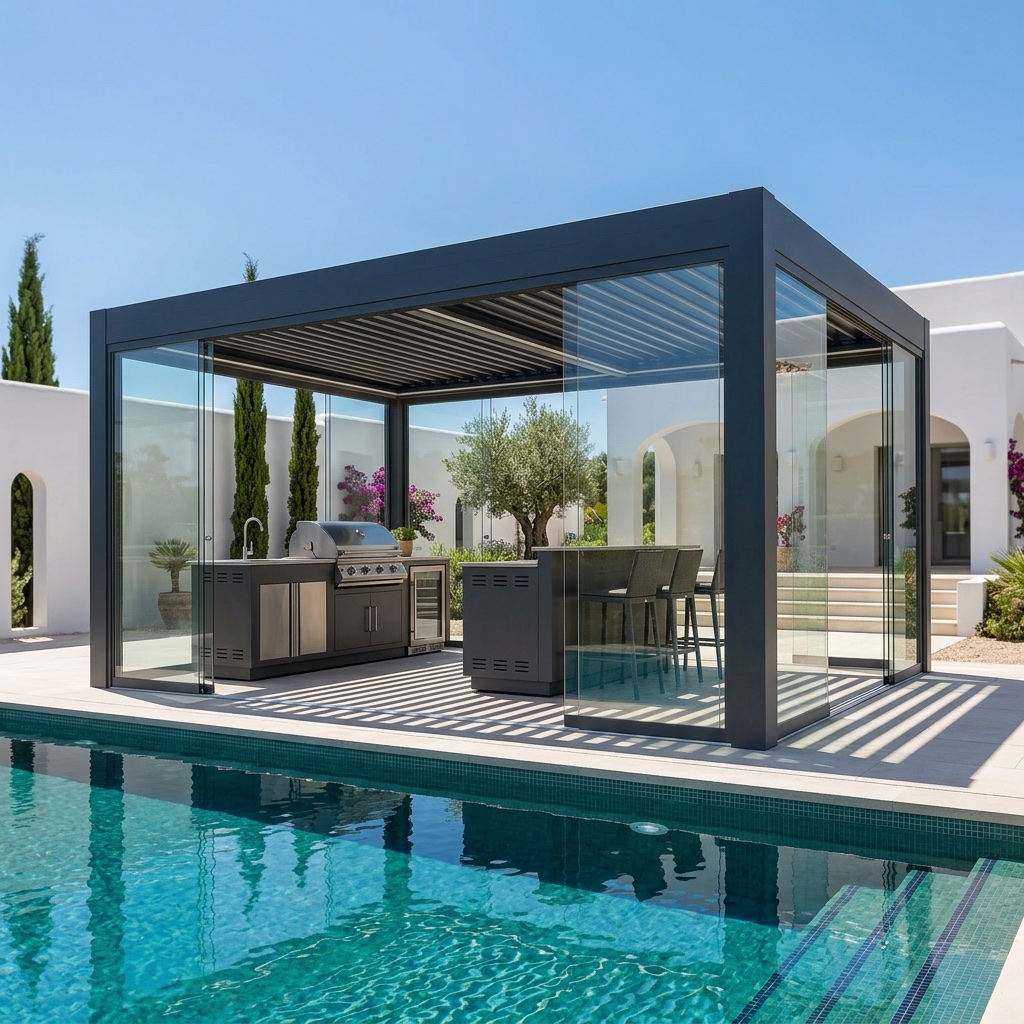
Pergola
An outdoor structure with an open, slatted, or louvered roof. Adjustable louvers let you change the amount of direct sun and airflow over the patio.
- Open roof or adjustable louvers
- Freestanding or attached layouts
- Modern, linear profile

Pergola vs gazebo
Choose by roof behavior before choosing by appearance. A pergola is commonly open, slatted, or louvered; a gazebo commonly carries a fixed solid roof. That single distinction changes light, airflow, rain coverage, maintenance, and the character of the space below.
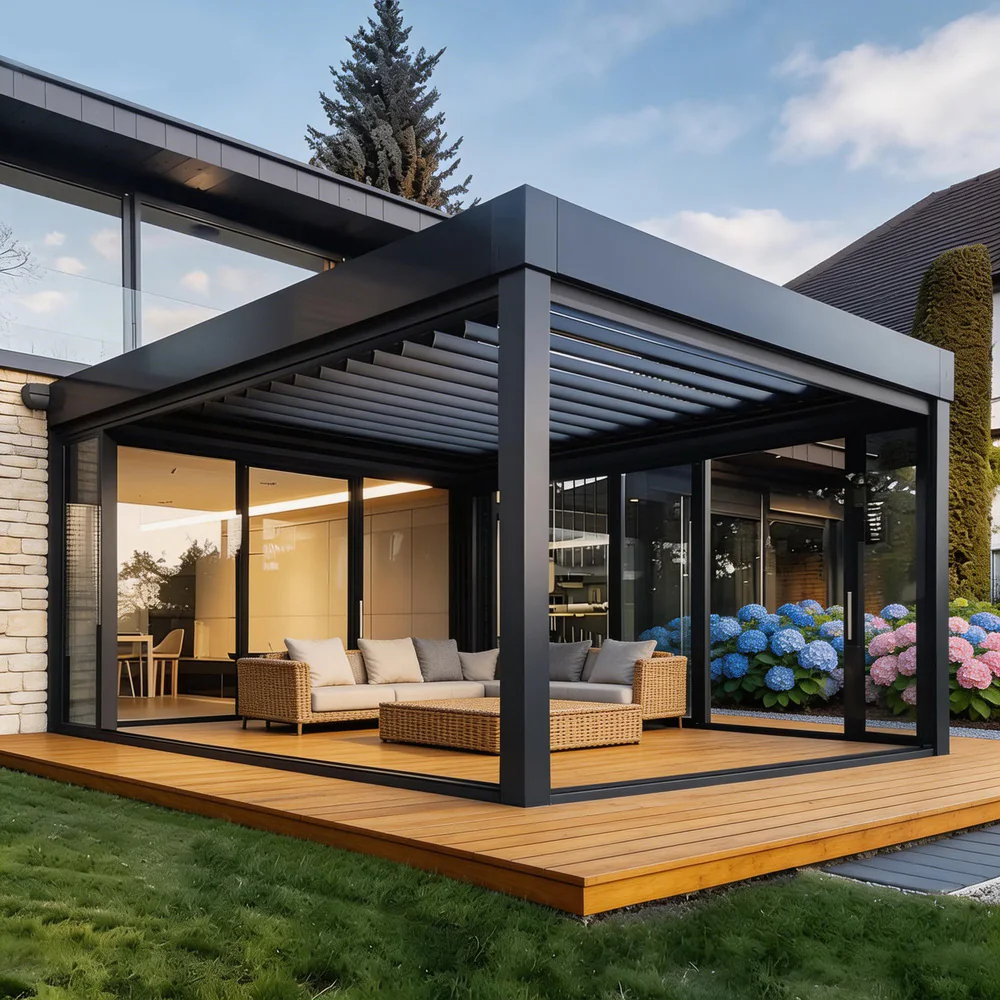
Your next best steps
Once you know whether adjustable shade fits, connect that choice to weather control, total cost, and a specific package.
An outdoor structure with an open, slatted, or louvered roof. Adjustable louvers let you change the amount of direct sun and airflow over the patio.
A freestanding outdoor structure with a fixed solid roof, commonly built in a square, rectangular, round, or octagonal pavilion form.
Side-by-side
These are common category differences. Before buying, compare the actual roof, drainage system, design loads, foundation requirements, finish, and warranty for the specific product.
| Factor | Pergola | Gazebo |
|---|---|---|
| Typical roof | Open rafters, slats, or adjustable louvers | Fixed solid roof |
| Sun control | Filtered or adjustable, depending on roof | Full-time shade below the roof |
| Rain coverage | Depends on the roof; closed louver systems can provide rain protection | Solid roof typically sheds rain continuously |
| Airflow | Open roof and sides allow more airflow | Solid roof holds more warm air overhead |
| Typical style | Linear, open, and often contemporary | Pavilion-style and often traditional |
| Common layouts | Freestanding or attached | Usually freestanding |
| Common uses | Patios, outdoor kitchens, pool decks, and flexible seating areas | Picnic areas, spa shelters, and dedicated seating pavilions |
Whole-project comparison
Compare equivalent usable space and a complete installed scope. A category label does not tell you which structure will be less expensive or easier to approve on a particular site.
A gazebo creates predictable full-time overhead shade. That can be welcome over a picnic table or spa, but the solid roof can hold warmer air and reduce daylight at nearby windows. Ventilation depends on the roof shape and open sides.
An open pergola filters light without full rain cover. A louvered pergola adds a third option: open the blades for sky and rising warm air, angle them against direct sun, or move a compatible system to its documented closed position for ordinary rain management. Side screens, glass, and heaters change airflow and should be planned with the roof.
Gazebos often read as a separate garden pavilion. Pergolas commonly use a lower, linear roofline that can extend a patio or align with a modern house. Either structure can overwhelm a small yard if posts interrupt paths, views, doors, pool clearances, or the furniture zone.
Both structures transfer wind and gravity loads into anchors and a suitable foundation. Neither decorative pavers nor an unknown patio slab should be assumed adequate. A fixed gazebo roof sheds water continuously; a louvered roof needs clear gutters, post drains, and discharge locations that protect foundations and walkways.
Compare frame and roof materials, finish, size, foundations, anchors, freight, unloading, assembly, electrical work, screens or panels, permits, taxes, inspections, maintenance, and warranty. A motorized pergola may add drives, controls, and wiring; a gazebo may add roofing, flashing, ventilation, or more site-built labor.
Ask both sellers for drawings, design criteria, written inclusions, exclusions, delivery terms, and local-installation responsibilities. Only then is the pergola vs gazebo price comparison using the same boundary.
Pergola vs arbor
An arbor is usually a compact garden passage or seat marker, often with an arched or open trellis for climbing plants. A pergola is typically a larger outdoor-room structure sized for dining, cooking, lounging, or an adjustable roof.
| Factor | Pergola | Arbor |
|---|---|---|
| Typical purpose | Occupiable outdoor room | Garden entry, passage, or small seat |
| Typical footprint | Furniture-scale | Pathway-scale |
| Roof | Open rafters, slats, or adjustable louvers | Open trellis, often for plants |
| Common decision | Comfort, weather control, drainage, and project scope | Landscape character and plant support |
The difference between pergola and gazebo remains primarily the roof and pavilion form; the pergola vs arbor decision is more about scale and function. A single comparison page covers these related questions without creating mirror pages for “gazebo vs pergola” and other word-order variants.
A pergola is the better fit when you want sunlight and airflow at some times of day and more shade at others. Adjustable louvers can open for morning light, rotate against afternoon sun, and close for rain protection within the product's design limits. The straight roofline also works well beside contemporary homes, pools, and outdoor kitchens.
A gazebo is the better fit when permanent overhead cover matters more than adjustable sunlight. Its solid roof suits a dedicated picnic area, spa shelter, or seating pavilion, especially when a traditional roof shape complements the house.
A louvered pergola uses rotating blades instead of fixed open rafters. Open louvers admit sunlight and help warm air escape. On compatible systems, closed louvers overlap or interlock and shed rain into integrated perimeter gutters and post drains. That gives the structure more weather control without turning it into a solid-roof pavilion.
Before you buy
Ask for the applicable wind and snow criteria, foundation assumptions, anchor requirements, drainage capacity, and submittal documents for local review.
Identify the frame, roof, anchors, electrical components, side enclosures, freight, unloading, installation, and permit support as separate line items.
Compare finish care, fastener inspections, moving parts, gutter cleaning, replacement-part availability, and written warranty terms.
Pergola vs gazebo FAQ
A gazebo's solid roof normally provides continuous overhead rain cover. An open-roof pergola does not. A compatible closed louver roof can shed ordinary rain into integrated drainage, but open sides, wind-driven rain, drainage capacity, maintenance, and product limits still matter.
It depends on sun, roof position, color, airflow, and surrounding surfaces. Open or angled louvers can release warm air, while a solid roof blocks more direct sun continuously. Test the intended location during the hours when the space will be used.
Neither category is always more expensive. Compare equal footprints and include the exact roof, materials, finish, site work, foundation, anchors, delivery, labor, electrical scope, options, permits, taxes, maintenance, and warranty.
Requirements depend on the site and local authority, but both structures need an appropriate load path into verified anchors and a suitable structural base. Check setbacks, height, footprint, utilities, design loads, and submittal rules before ordering.
Want an adjustable louvered roof?
Review manual and motorized louvers, standard and custom footprints, freestanding and attached layouts, and factory-prepared accessories.